
By Derek Hempshall
Writer of Grassroots football: 1960 to 1980
If you played grassroots football in the 1960’s and 1970’s, this book is for you. During that time I played nearly a thousand matches. I will introduce you to the teams that I played for and the lads who made them successful, or not so! There are results, league tables and press reports, team photos, and my thoughts about injuries and referees!
The start of Sunday football in the Coventry area would prove a runaway success, and it coincided with the Sky Blue revolution of Coventry City FC.
In 1957 Harold McMillan said “You’ve never had it so good!”
What was family life like prior to the 1960’s?
Can you remember how slow life was in the fast lane?
How did World events affect your life in the two decades?
Grassroots Football is the lowest level at which teenagers and adults can play soccer competitively. The Football League has a pyramid system, which is bound together by promotion and relegation. It is possible, in theory, for a lowly amateur club to rise to the pinnacle of the English game. This system does not include Sunday football.
Grassroots Football is not for professional or semi-professional players, it is for amateur players and is sometimes referred to as ‘Junior’ or ‘Non-League’ and comes under the jurisdiction of the Local Football Association. In the Coventry and District area, all football clubs are affiliated to the Birmingham FA.
I had recently retired and was looking for something to fill the time of day. The last twenty years was spent looking into a computer screen, so daytime television was out of the question! Before I left work, I had discussed my options with my two workmates, Dean Sturgess and Mike Tuckett, (I’m going to miss them!). Dean had said, “...you’re good with words, you should write a book”. What a brilliant idea!
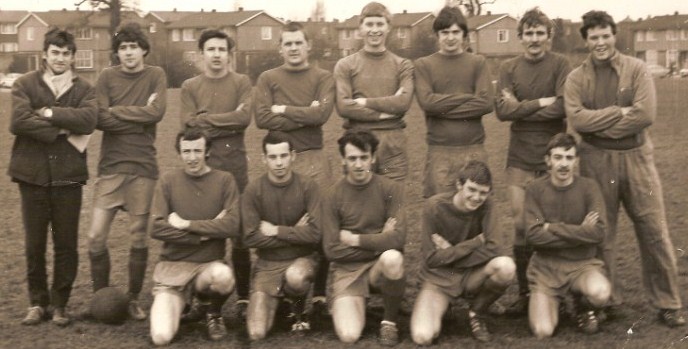
AC Godiva 1968
The inspiration to write this book came from a photograph published recently in the Coventry Evening Telegraph. The picture was of a local amateur football team, Grange United, who fifty years before, had played a game against a rival team, Longford Rangers. The match was played on a local parks pitch which was surrounded by possibly two thousand people, standing ten to fifteen deep. The atmosphere was electric! It was a ‘David and Goliath’ event, Grange United were the new kids on the block, and Longford Rangers were the Coventry Combination’s top team for many years. The result of the game is not that important; in any case, there would be a return game the next week, and again the massed spectators weren’t going to miss a tackle, or a goal.
The photograph reminded me of the cup final I had played in front of such a crowd, not on a parks pitch, but at the Butts Stadium in Coventry. (Now rebuilt and the home of Coventry Rugby Club). Other memories followed, hence the book, a record of the 1960’s and 70’s, where football was an escape from the everyday routine of a teenage schoolboy passing along life’s highway, with a future that offered a secure job and a marriage with 2.4 children! The cocoon of a secure and happy existence was not to be; it was all at the risk of world events, over which I had no control!
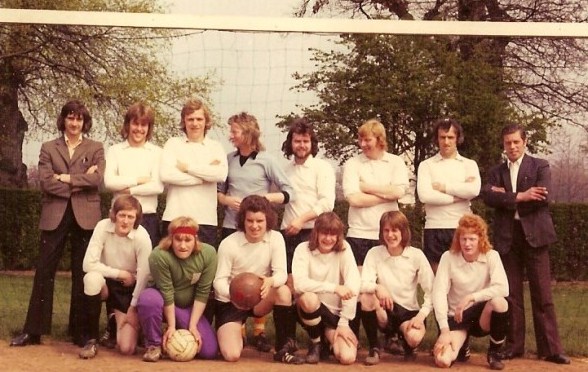
Barras Green WMC 1976
The British are sport mad, whether its football, rugby, cricket, tennis, cycling, horse racing, fishing, darts, snooker, skiing, yachting or athletics, or anything else you can name, we can’t get enough. The medium of television allows anyone to view the sport that interests them, from the comfort of their armchairs. We can watch highly paid and highly skilled professional persons ply their trade, or support dedicated amateur individuals as they battle against the odds. Ideally, we should make the effort to go to venues to watch their efforts, and indeed we do, as stadiums around the country hold sixty to eighty thousand visitors. The organisation of these events has developed over hundreds of years, and is near infallible. From the comfort of our homes we can book tickets and arrange travel. All we need to do is turn up on time, and enjoy the event.
The summer Olympics were held in this country for the first time since 1948, and a whole cluster of new arenas were built in London and elsewhere. The spectacle encouraged more people to take up sport and exercise to lead a fitter and more active life, rather than watch athletes and footballers on television. The taking part is everything!
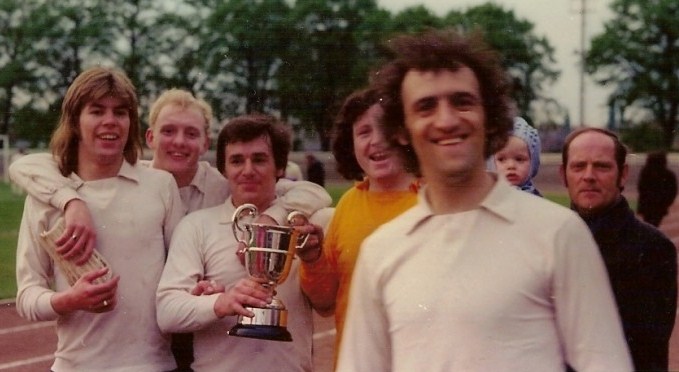
Barras Green Rangers, T Cooke Cup Winners 1974
In 1966 we had the Football World Cup to look forward to. It was an event that resurrected the ‘Dunkirk spirit’ and united the nation; even more so, when England won the Jules Rimet Trophy, beating Germany.
It was significant the post-war ‘baby boom’ led to a surge in the number of amateur football teams all over the country. At the beginning of the sixties, there were a lot of teenagers with time on their hands, and football was better than hanging around on street corners. With the increase of the number of teams in the league, it was difficult for the leagues administrators to assess the strength of the new sides, and for a few years there would be weak teams in high divisions and strong teams in lower divisions. The other problem was - where would all the new teams play their football?
The emergence of the Coventry and District Sunday Football League put pressure onto the Parks and Leisure Department to provide new pitches. They had sufficient land to mark out new pitches, but didn’t have adequate buildings for changing facilities. The cost of paying staff for two days at the weekend could be paid for by the football clubs. They coped somehow, but over the next twenty years, some of these facilities would disappear, not to be replaced; mainly because they were not fit for the purpose, or they had been vandalised beyond repair. The Stoke Heath changing rooms were one of the first buildings to be knocked down, and yet some of the pitches were still used for league matches; the players having to change in their cars along Mercer Avenue. Not satisfactory! In recent times, the City Council have just refurbished the changing rooms at the Memorial Park, as part of a big investment. I hope the showers work better than the previous ones!
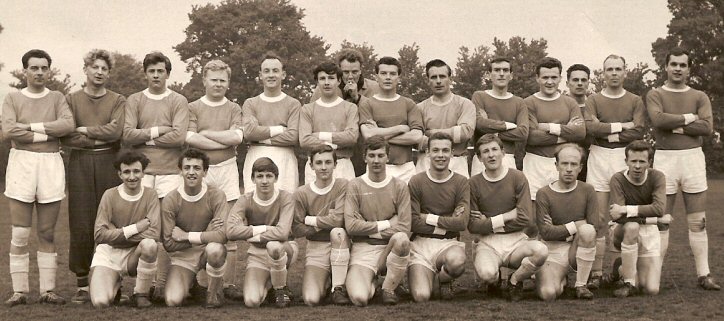
Moseley United FC 1965
I got a lot of enjoyment playing football during that period, and played nearly a thousand games. I still see some of the players I played with, and we always say that it would be nice to have a reunion, and chat about the good old days, because as we get older, we know more or less, what the future holds, and it is better to remember the past!
In writing this book, I wanted to talk about my experiences in amateur football and relate how it all fitted into the rest of my life. I hope that other footballers will read this, and be able to draw on their own memories. It isn’t that easy to recall every goal you scored, or each match you played in, but if you take one season at a time, you will be able to recall the events that shaped your lives
It is sad that former team-mates have passed away. I was aware of a few, but I was told of others, as I was researching the book, and I feel the loss.
'An excellent and well written: easy to read book from the life of a “grass-roots” footballer.
Well done Derek, you captured through your personnel memoirs an age sadly missed and it will bring back fond and poignant memories of all who grew up in that age of simplicity.'
Ray Staff - Avondale FC and ex-Wickman Apprentice
